Fall Lawn Care Tips for Beginners: The 5 Things That Actually Matter Before Winter (And the Rest You Can Skip)
By Tondio Team · AI-generated content
First fall as a homeowner? Skip the overwhelm. These 5 lawn care tasks are all you need for a healthy, green lawn come spring.
Fall Lawn Care Tips for Beginners: The 5 Things That Actually Matter Before Winter (And the Rest You Can Skip)
Most first-time homeowners spend their first fall either doing nothing to their lawn or spiraling into a 47-tab research hole about aeration schedules, soil pH, and overseeding rates. Both approaches are mistakes.
Here's the truth: fall is actually the most important season for your lawn, but you don't need to do everything the YouTube pros recommend to see real results. A handful of well-timed, well-executed tasks will set your grass up for a genuinely healthy spring — and the rest can wait, be skipped, or just doesn't matter as much as the internet wants you to think.
This guide cuts straight to what actually moves the needle. Five tasks, ranked by impact. Clear explanations for why each one matters. And an honest list of the stuff you can safely ignore this year without feeling guilty about it.
The 5 Non-Negotiable Fall Lawn Tasks (Ranked by ROI)
1. Adjust Your Mowing Height Before the Last Cut
This one costs you nothing and takes about 30 seconds to do — but skipping it is one of the most common beginner mistakes that leads to a rough-looking spring lawn.
Here's the target: mow your grass down to 2 to 2.5 inches for your final cut of the season. Most homeowners mow at 3 to 4 inches during summer (which is correct for summer), but heading into winter at that height creates problems. Tall grass traps moisture and creates the perfect environment for snow mold and fungal disease to develop under the snow.
The timing matters too. You're not doing a dramatic scalp job — you're gradually stepping down your height over your last 2 to 3 mows in October. Lower it by about half an inch each session rather than dropping it all at once.
Why it works: Shorter grass going into winter means less surface area for disease, less matting under snow and leaves, and a cleaner slate for spring growth.
Pro Tip: Not sure when your "last mow" will actually be? A good rule of thumb is to stop mowing when your grass stops actively growing — which typically happens when daytime temperatures consistently drop below 50°F. In most northern climates, that's mid-to-late October. In the South, it may be November or later.
2. Apply One Round of Fall Fertilizer
If you only do one thing for your lawn this fall, make it this. A single, well-timed fall fertilizer application is the highest-ROI thing a beginner can do. Full stop.
What to Buy
Look for a fertilizer with a high potassium and moderate nitrogen content. A bag labeled something like 24-0-10 or 32-0-10 (those numbers are Nitrogen-Phosphorus-Potassium, or N-P-K) works well for fall. The nitrogen feeds the grass now, and the potassium strengthens root systems and improves cold hardiness going into winter.
Avoid anything with a very high middle number (phosphorus) unless a soil test has told you your soil is deficient — most established lawns don't need it, and excess phosphorus can run off into local waterways.
When to Apply It
The sweet spot is when soil temperatures are between 50°F and 65°F — typically mid-September through mid-October in northern climates, and as late as early November in warmer regions. Apply too early and you're pushing top growth at the wrong time. Apply after the ground freezes and the nutrients can't be absorbed at all.
How Much to Apply
Follow the bag's directions for your grass type and square footage. As a general starting point, you're aiming to apply about 1 pound of actual nitrogen per 1,000 square feet. To calculate that: if your fertilizer is 24% nitrogen (the first number on the bag) and you have 5,000 square feet of lawn, you need about 20.8 pounds of fertilizer total (5 ÷ 0.24).
Tondio makes this calculation simple — enter your lawn's square footage and the product's NPK, and it'll tell you exactly how many bags to buy and how to set your spreader.
Pro Tip: Apply when the grass is dry but the ground is moist, and water it in lightly afterward if rain isn't in the forecast within 24 hours. This gets the nutrients moving into the soil instead of sitting on the surface.
3. Stay on Top of Leaf Removal
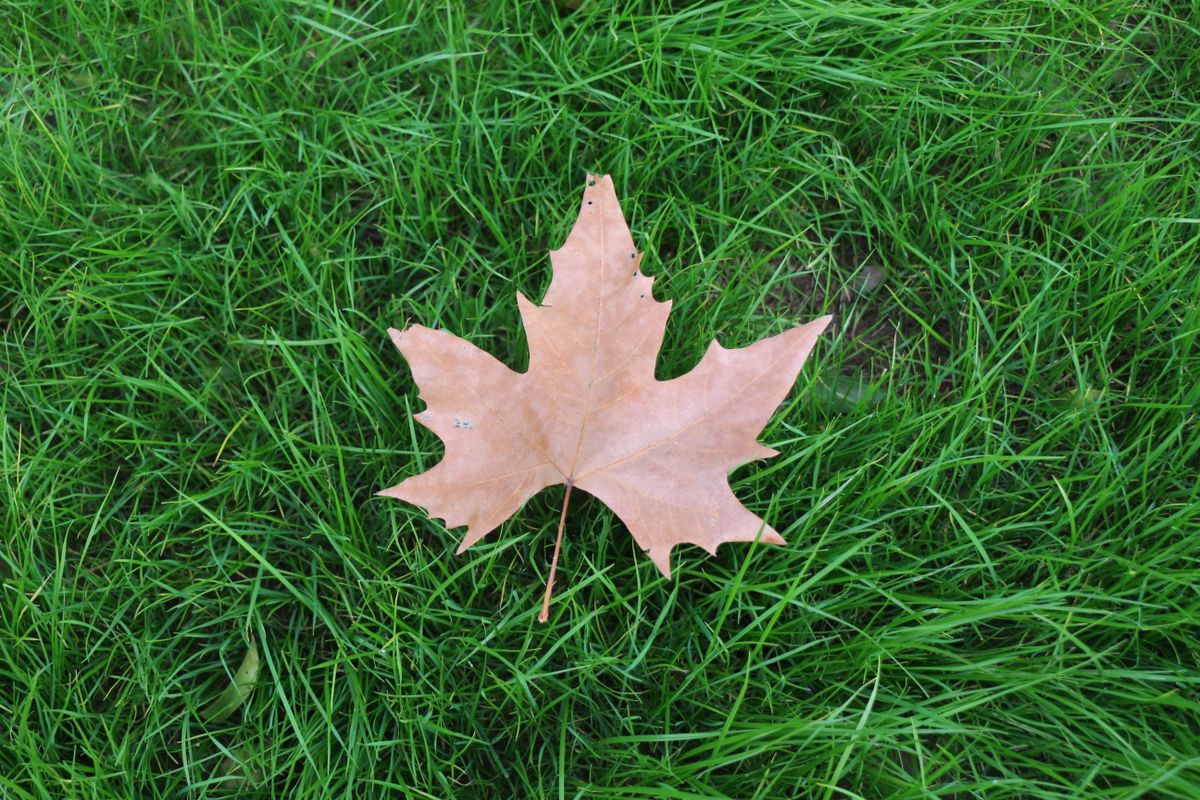
Here's the thing about leaves: a light layer is fine. A thick, matted blanket left sitting on your lawn for weeks is not. Leaves block sunlight, trap moisture, and can smother grass — especially if they get wet and pack down.
You don't have to rake every single leaf the moment it falls. But you do need a system that keeps the coverage manageable before they accumulate.
Your Options
- Mulch-mow the leaves: Run your mower over a light layer of leaves (no more than about an inch deep) and let the shredded pieces filter down between grass blades. This actually adds organic matter back to your soil — it's a legitimate win. Just don't do this with a thick, packed layer of wet leaves.
- Rake or blow them off: For heavy accumulations or large wet leaves (think maple or oak), move them off the lawn entirely. Add them to a compost pile if you have one.
- Combination approach: Mulch early in the season when leaves are light and dry, then switch to raking as they get deeper in October and November.
The line in the sand: if you can't see grass through the leaf layer, it's too thick to mulch. Clear them out.
Pro Tip: Set a recurring reminder in Tondio for weekly leaf checks in October and November so it doesn't sneak up on you. What looks manageable on Monday can turn into a matted mess by Friday after a rain.
4. Treat Visible Weeds Now (Not in Spring)
Fall is actually a better time to treat weeds than spring — and most beginners don't know this. Here's why it works: weeds are in the same mode as your lawn right now, pulling energy and nutrients down into their roots to prepare for winter. When you apply a broadleaf herbicide in fall, it travels right along with that downward flow and hits the root system directly.
Spring applications, by contrast, catch weeds while they're actively growing upward — you're fighting the current instead of going with it.
What to Treat
Focus on broadleaf weeds you can actually see: dandelions, clover, plantain, and ground ivy are the most common beginner battles. These respond well to spot-treatment with a liquid broadleaf herbicide (look for one containing 2,4-D, MCPP, or dicamba — or a combination of the three).
When to Apply
Apply when air temperatures are between 60°F and 80°F and rain isn't expected for at least 24 hours. Most broadleaf herbicides need that window to absorb through the leaf surface before they can start working.
You don't need to treat the whole lawn — spot treating the visible problem areas is enough for a first year. Don't waste product or money blanket-spraying a lawn that's mostly fine.
Pro Tip: Take photos of your weedy spots before and after treatment using Tondio's photo documentation feature. It's surprisingly satisfying to compare them side by side in spring, and it helps you track whether a product actually worked so you know what to restock next year.
Photo by adrian vieriu on Pexels
5. Properly Store Your Mower Before Winter
This one gets skipped constantly, and it costs beginners real money. A mower that isn't prepped for winter storage is a mower that may not start in spring — or one that needs a costly carburetor cleaning before you can use it.
This task takes about 20 to 30 minutes and protects what's likely a $300 to $600 piece of equipment (or more).
The Checklist
- Stabilize or drain the fuel: Old gas left in the tank over winter goes stale, gums up the carburetor, and causes hard-start issues. Either add a fuel stabilizer (like Sta-Bil) to a full tank and run the engine for a few minutes to circulate it, or drain the tank completely and run the engine until it dies.
- Change the oil: Dirty oil left over winter degrades further and can cause engine wear. Drain it, swap it for fresh oil at the viscosity your manual recommends (usually SAE 30 for most walk-behind mowers).
- Replace or clean the air filter: A clogged filter is a common reason mowers run rough in spring. Foam filters can be washed; paper filters should be replaced. Usually costs $5 to $10.
- Sharpen or replace the blade: You can do this now or in early spring, but doing it now means you're not scrambling when lawn season starts.
- Clean the undercarriage: Dried grass clippings and debris under the deck trap moisture and accelerate rust. Scrape it clean with a putty knife or stiff brush.
Pro Tip: Log your mower maintenance in Tondio so you have a running record of when you last changed the oil, replaced the blade, and serviced the air filter. When spring rolls around, you'll know exactly where you left off instead of guessing.
What You Can Safely Skip This Fall (Without Hurting Your Lawn)
This is the part nobody tells you. Here are the fall tasks that get heavy coverage online but are genuinely optional — especially for beginners in their first year.
Aeration (If You Did It Recently)
Aeration is valuable, but you don't need to aerate every single year. If your lawn was aerated within the last 12 to 18 months, skip it. If your soil is compacted and you've never aerated, it could be worth doing — but it's not the emergency it's often made out to be for a first year. You can add it to next fall's plan with no consequences.
Overseeding Thin Spots
Overseeding is great — but it's also a bigger commitment than most beginners expect. Freshly seeded areas need consistent moisture for 3 to 4 weeks, protection from foot traffic, and precise timing. If you missed the ideal overseeding window (typically late August through mid-September for cool-season grasses), don't seed now just to check the box. Late overseeding often results in weak seedlings that don't survive their first winter. Wait until next fall when you can plan for it properly.
Soil Testing (For the First Time)
Soil testing is genuinely useful — eventually. But your first fall is not the time to prioritize it. A soil test takes time to interpret and act on, and the corrective treatments (like lime for low pH) can take months to work. Focus on the five core tasks first. If you want to do a soil test in your second or third year when you have a baseline feel for your lawn, that's the right time.
Common Beginner Mistakes in Fall Lawn Care (And How to Avoid Them)
Mistake 1: Applying Too Much Fertilizer Too Late in the Season
More is not better with fall fertilizer. Applying a heavy nitrogen application after the ground has started to cool (below 50°F soil temp) pushes tender new top growth that immediately gets hit by frost. That kills the new growth, stresses the plant, and wastes your money.
Stick to the 1 pound of actual nitrogen per 1,000 square feet guideline and apply it during that 50°F to 65°F soil temperature window. One application is all you need.
Mistake 2: Scalping the Last Mow
Dropping your mowing height is good. Dropping it all at once by 2 or 3 inches — commonly called scalping — is bad. Removing more than one-third of the grass blade at once stresses the plant and can damage or kill it heading into a vulnerable season.
Step down gradually. If you're at 3.5 inches now, go to 3 inches, then 2.5 inches over your last few mows. That's all it takes.
Mistake 3: Leaving Mulched Leaves Too Thick
Mulch-mowing is great — up to a point. The mistake is assuming that mulching always beats raking, no matter how many leaves are on the lawn. A thick layer of mulched leaves can mat down, block light, and create fungal conditions just as badly as whole leaves can.
The rule is simple: if you can still see grass through the layer, mulch away. If the leaves are so thick you can't see the lawn underneath, rake first, then mulch what's left.
Mistake 4: Skipping Mower Prep and Regretting It in April
We covered this above, but it's worth repeating: the 20 minutes you spend prepping your mower in October saves you hours of frustration — and potentially hundreds of dollars in repairs — in spring. Don't skip it.
Your Fall Lawn Care Action Plan
Here's your complete beginner fall checklist, in order of when to do it:
September / Early October
- Apply fall fertilizer (soil temp 50°F–65°F window)
- Begin stepping mowing height down gradually toward 2–2.5 inches
- Spot-treat visible broadleaf weeds with a liquid herbicide
October / November
- Keep up with weekly leaf removal (rake, blow, or mulch-mow)
- Complete final mow at 2–2.5 inches once grass stops actively growing
After Your Final Mow
- Stabilize or drain mower fuel
- Change mower oil
- Clean or replace air filter
- Sharpen mower blade
- Clean undercarriage
- Log maintenance in Tondio
You've Got This
Fall lawn care doesn't have to be complicated. Adjust your mow height. Put down one round of fertilizer at the right time. Clear the leaves. Hit the weeds. Store your mower properly. That's genuinely it for a beginner's first year — and if you nail those five things, your lawn will come out of winter in far better shape than most of your neighbors'.
The rest of it — the aeration debates, the overseeding math, the soil test spreadsheets — that's for future-you to tackle once you've got the fundamentals locked in.
If you want to take the guesswork out of timing all of this, Tondio can help you set seasonal reminders, track your applications, and document your lawn's progress so spring isn't a mystery. Start simple, stay consistent, and your lawn will reward you for it.
Now go check your soil thermometer.