Why Is My Lawn Mower Backfiring and Is It Safe to Keep Running It

Photo by Joel Hägele on Pexels
By Tondio Team · AI-generated content
Lawn mower backfiring? Learn the 3 mechanical causes, how to tell if it's safe to keep running, and when to stop immediately before damage is done.
Why Is My Lawn Mower Backfiring and Is It Safe to Keep Running It
That sharp crack or bang coming from your mower isn't just startling — it's your engine telling you something is wrong. The question is whether it's whispering "fix me soon" or screaming "shut me down right now."
Backfiring is one of those symptoms that sends lawn owners straight to Google at 9am on a Saturday, mid-mow, with half the yard still uncut. And the frustrating part? Most of what you'll find lumps it in with general engine problems, smoking issues, or no-start diagnostics. Backfiring is its own specific symptom with its own specific causes — and knowing the difference between a pop at shutdown and a bang while you're running could save your engine, your wallet, or both.
Here's exactly what's happening inside that engine, what each type of backfire means, and — most importantly — whether you should kill the engine immediately or finish the job first.
Backfire vs. Afterfire: These Are Not the Same Thing
Before you diagnose anything, you need to know which kind of "bang" you're actually dealing with. Most people use "backfire" to describe any unexpected pop or explosion from their mower, but there are actually two distinct events with completely different root causes and urgency levels.
The Pop at Shutdown (Afterfire)
If your mower makes a single pop or bang when you turn it off — or within a second or two of shutting down — that's technically an afterfire, not a true backfire. It happens through the exhaust and sounds like a small gunshot.
What causes it: When you cut the throttle quickly, the engine speed drops but there's still unburned fuel sitting in the combustion chamber or exhaust. The residual heat ignites that fuel after the spark plug has already fired its last cycle, and — bang.
How urgent is it? Honestly, a single clean afterfire on shutdown is more of a nuisance than a danger. It's the most common backfire complaint, and it's almost always caused by one of two things:
- Shutting the engine down too quickly from a high throttle setting (operator habit)
- A slightly rich fuel mixture leaving excess unburned fuel in the system
The fix is simple: Always bring your throttle down to idle and let the engine run for 10–15 seconds before shutting it off. This lets the combustion chamber clear out. If the afterfiring stops, you just fixed it with zero tools and zero money.
Pro tip: If your mower has a separate choke lever, make sure the choke is fully open when you're trying to shut down. Running it partially choked traps extra fuel vapor in the system and makes afterfiring significantly worse.
True Backfire While Running
This is the one that should get your attention. A backfire while the engine is running — a loud pop, bang, or series of pops during normal operation — is a different animal entirely. This means combustion is happening somewhere it shouldn't be: either before the intake valve fully closes, back through the carburetor, or at the wrong point in the piston cycle.
You might notice it:
- On acceleration or when the load suddenly increases (hitting thick grass)
- At a consistent RPM range — the engine seems fine until it hits a certain speed
- Randomly during a mow with no obvious pattern
- Combined with rough running, surging, or black smoke from the exhaust
This type of backfire means something mechanical is off, and the distinction between which mechanical thing is off determines whether you should keep mowing or park it immediately.
Let's break down the three main causes.
The 3 Mechanical Causes of Lawn Mower Backfiring
1. Late Ignition Timing
What it is: Your engine fires the spark plug at a precise moment — typically somewhere between 20° and 28° before top dead center (BTDC) depending on the engine. If that timing slips and the plug fires late — closer to or after top dead center — the fuel-air mixture is still burning as the exhaust valve opens. That burning mixture meets fresh oxygen in the exhaust port and you get a backfire.
What causes timing to slip on a small engine? On most modern residential mowers, ignition timing is fixed — there's no distributor to adjust like on a car. Timing is set mechanically by the position of the flywheel and the ignition coil. So if timing has gone off, it usually means:
- The flywheel key is sheared or partially sheared. This is the most common timing-related cause on walk-behind and riding mowers. The flywheel key is a small, soft metal key (usually aluminum) that locks the flywheel to the crankshaft in the correct position. It's designed to shear if the blade hits something solid — it sacrifices itself to protect the crankshaft. A fully sheared key will stop your engine. A partially sheared key will let the engine run, but with retarded timing — and that means backfiring under load.
- The ignition coil has shifted position. The air gap between the coil and flywheel magnets should be set at 0.010 inches (about the thickness of a business card). If the coil has moved, timing and spark quality both suffer.
Stop or keep going? Stop immediately if you suspect a sheared flywheel key. Running an engine with a partially sheared key is unpredictable — it can seize, the timing can shift further mid-mow, and you risk damaging the crankshaft. Replacing a flywheel key is a $3–5 part and a 30-minute job. Replacing a crankshaft is not.
How to check: Pull the spark plug wire, remove the blade, and inspect the flywheel key. It should have clean, square edges on both sides. If it looks angled, twisted, or if the keyway slot looks widened, replace it before you mow again.
2. Rich Fuel Mixture
What it is: A rich mixture means too much fuel relative to air is entering the combustion chamber. The ideal air-to-fuel ratio for a small gasoline engine is 14.7:1 by weight — that's 14.7 parts air to every 1 part fuel. When that ratio tips toward more fuel (say, 10:1 or 11:1), the mixture doesn't combust completely during the power stroke. That excess fuel gets pushed out through the exhaust or intake still burning, which causes backfiring — often with black or dark gray smoke.
What causes a rich mixture?
- A dirty or gummed carburetor. Over a season of use, the tiny passages and jets inside the carb accumulate varnish deposits from fuel breaking down. The main jet, pilot jet, and needle seat can all partially clog — and a clogged pilot jet, specifically, tends to create an overly rich mixture at low throttle. This is one of the most common causes of backfiring on mowers that haven't had a carb cleaning in 2–3 seasons.
- A stuck or misadjusted choke. If the choke plate isn't opening fully, the engine is starved of air at all times — essentially running in permanent "cold start" mode. This chokes the intake and creates a persistently rich condition.
- A leaking or stuck float. Inside the carburetor bowl, the float controls how much fuel enters the system. If it's stuck open or leaking fuel into itself (hollow floats can take on fuel over time), the carburetor floods and runs rich.
- A clogged air filter. Don't overlook the obvious one. A foam or paper air filter that's packed with grass clippings, dust, and oil restricts airflow into the engine just as effectively as a partially closed choke. Replace foam filters every season. Paper filters? Tap them out and replace them if they're gray or oil-stained.
Stop or keep going? This depends on severity:
- Occasional backfire with no smoke, runs mostly fine: Finish the current mow, but don't start it again until you've cleaned the carb or replaced the air filter. Running a mildly rich engine won't destroy it in one session, but repeatedly running rich washes oil off cylinder walls over time.
- Frequent backfiring + black smoke + hard starting: Stop now. This combination means the carb is significantly fouled. You're burning excess fuel, potentially fouling the spark plug (which causes misfires, which cause more unburned fuel, which causes more backfiring — a cycle that gets worse fast), and running the risk of a hydrolocked cylinder if enough raw fuel accumulates.
3. Stale or Degraded Fuel — The Spring Startup Special
This one deserves its own spotlight because it's the number one cause of backfiring complaints in spring — and it's completely preventable.
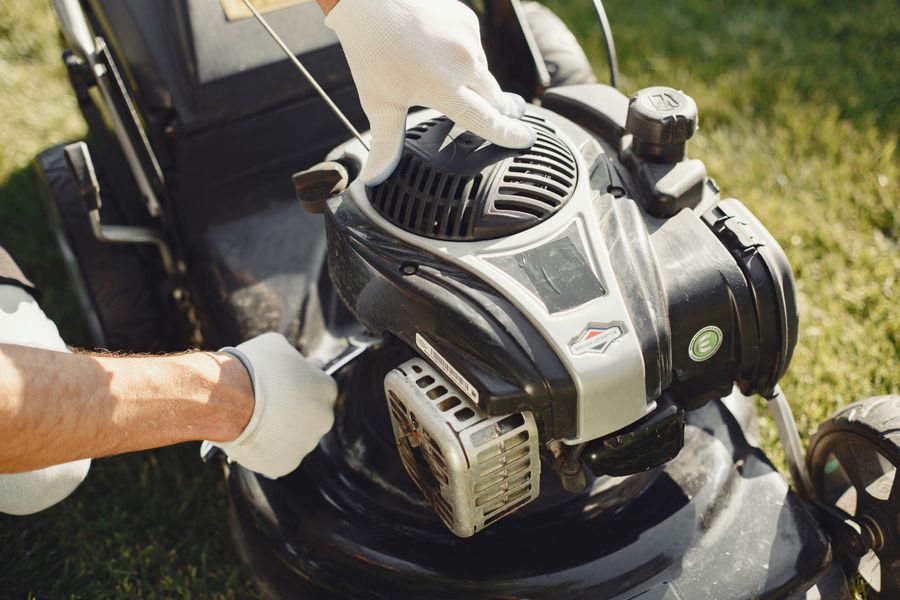
Photo by Gustavo Fring on Pexels
Here's what happens: You park the mower in November with fuel in the tank. Modern pump gasoline containing ethanol (typically E10 — 10% ethanol) begins to degrade in as little as 30 days. By spring, that fuel has been sitting for 4–5 months. The light volatile compounds have evaporated, the ethanol has absorbed moisture from the air, and the remaining fuel is thicker, gummier, and has a much lower octane rating than fresh gas.
When you fire that mower up in April and it backfires, hesitates, surges, or runs rough — stale fuel is the first suspect, not a mechanical failure.
Stale fuel creates problems in two ways simultaneously:
- It burns inconsistently — the degraded combustion profile means the timing of the burn inside the cylinder is irregular, which shows up as popping and backfiring.
- It leaves varnish deposits on carburetor jets — even one season of stale fuel sitting in the carb bowl can partially clog the pilot jet, creating that rich-mixture backfiring described above.
The quick drain-and-refuel fix:
- Run the tank as low as you can before storing (or use a fuel shutoff valve and run the carb dry).
- If you didn't do that, drain the tank completely — a hand pump or siphon works fine.
- Remove the carb bowl (usually one bolt on the bottom) and check for varnish — it looks like yellowish or brown sticky residue. Spray carb cleaner in the jets.
- Add fresh 87–91 octane fuel. Avoid E85 or high-ethanol blends. For small engines, fuel with no ethanol or E10 max is ideal.
- Add a fuel stabilizer if you're going to store fuel in a container longer than 30 days. Products like Sta-Bil at the recommended ratio of 1 oz per 2.5 gallons will keep fuel viable for up to 24 months.
Stop or keep going? If you strongly suspect stale fuel is the sole issue and the backfiring is minor, you can finish the current mow — but drain and refuel before the next start. Don't let stale fuel sit in a warm engine over another week.
Using Tondio to track your last fuel date is a small habit that saves real headaches. Log when you filled up and with what — so next spring, you know exactly how old that fuel is before you pull the cord. No more guessing if it's been 3 months or 6.
The "Stop or Keep Going" Decision — A Quick Reference
Here's the honest breakdown. Not every backfire requires the same response:
| Symptom | Likely Cause | Safe to Finish? |
|---|---|---|
| Single pop at shutdown only | Afterfire / quick throttle cutoff | Yes — adjust shutdown habit |
| Occasional pop while running, no smoke | Mild rich mix or stale fuel | Finish this mow, fix before next |
| Frequent backfire + black smoke | Fouled carb / very rich mixture | Stop now |
| Backfire + hard starting + surging | Clogged carb jets | Stop now |
| Backfire after hitting an object | Possible sheared flywheel key | Stop immediately |
| Backfire + metallic noise or knock | Possible internal engine damage | Stop immediately, don't restart |
When Backfiring Combined with Other Symptoms Means Carb Service is Overdue
A backfire on its own is a yellow flag. Backfiring combined with any of the following is a red flag that your carburetor needs to be cleaned or rebuilt before you mow again:
- Hard starting that requires more than 3–4 pulls — the pilot jet is likely partially blocked, disrupting the starting fuel circuit
- Black or very dark gray exhaust smoke — unambiguous sign of rich combustion; you're burning more fuel than the engine can process
- Surging or hunting — the RPM rises and falls rhythmically while idling or running at constant speed; this is the carb trying and failing to maintain a stable fuel-air mixture
- Fouled spark plug — if you pull the plug and it's black and sooty rather than light tan, the engine has been running rich for a while
Carburetor cleaning is not a complex job. On most residential push mower engines — Briggs & Stratton 500–725cc series, Honda GCV160/190, Kawasaki FJ180 — a basic carb clean takes about 45 minutes with a $4 can of carb cleaner and a set of small screwdrivers. A full rebuild kit (new gaskets, needle, float pin) runs $8–15 online and is the smarter move if the carb is more than 4–5 years old.
Pro tip: Photograph every step of the disassembly before you pull anything apart. Better yet, use Tondio's's photo documentation feature to log your mower's maintenance records visually — so you have a timestamped reference of what the carb looked like before and after cleaning, and you're not squinting at a blurry phone photo six months later trying to remember where that spring went.
Spring Startup Checklist to Prevent Backfiring
Most spring backfiring issues are preventable. Run through this before the first mow of the season:
- Drain and replace fuel if it's been sitting more than 60 days without stabilizer (30 days if it's E10 without stabilizer)
- Inspect and replace the air filter — foam filters every season, paper filters if visibly dirty or oil-stained
- Check the spark plug — replace if electrodes are worn or plug face is heavily carbon-fouled; most small engine plugs should be replaced every 100 hours or annually (standard plugs run $3–6)
- Inspect the carburetor bowl — remove, drain, and check for varnish deposits; spray jets with carb cleaner if any residue is visible
- Check the choke plate — should move freely and return fully to the open position when warm
- Inspect the blade — a bent or unbalanced blade causes vibration that can loosen the ignition coil over time
- Verify ignition coil gap — set to 0.010 inches (business card thickness) between coil and flywheel magnet
- Check flywheel key — especially if the mower hit something solid last season
Tondio lets you set seasonal maintenance reminders so this checklist runs on autopilot. Schedule your spring startup service in early April and get a reminder before you ever pull the cord — not after the backfiring starts.
Don't Ignore the Pattern — Track Your Mower's History
Here's something most backfiring guides won't tell you: a single backfire that goes away is less useful information than a pattern of backfires.
If your mower backfired once at startup in April, ran fine all season, and backfired once at shutdown in October — that's two isolated events with different causes. No big deal.
If your mower backfired at startup in April, again in June when you hit a rough patch, and now it's doing it every mow in August — that's a pattern that points toward a carburetor that's been getting progressively more fouled all season. Catching that pattern in July instead of August means a $15 carb kit instead of a $120 carburetor replacement.
This is exactly why Tondio includes a maintenance log where you can note issues, symptoms, and service events for each piece of equipment. When you log "backfired twice on startup" in April and then see that note again in June, you've got actionable data instead of a vague feeling that "the mower has been acting weird lately."
The Bottom Line
A backfiring lawn mower is not always an emergency — but it's always a message. The key is knowing which message it's sending.
A single pop at shutdown is almost certainly an afterfire from a quick throttle cut, and adjusting how you shut the engine down will fix it completely. A spring backfire on first startup is almost always stale fuel, and a drain-and-refuel takes 20 minutes. But backfiring combined with black smoke, hard starting, or a recent impact event means you should stop the engine, diagnose the specific cause, and fix it before the next mow — full stop.
The mowers that turn into expensive repair bills are almost never the ones that failed suddenly. They're the ones where the owner heard a warning sign, thought "it seems fine otherwise," and kept going for another six weekends. Don't be that person.
Handle the backfire now, log the fix, and your mower will reward you with seasons of reliable starts and smooth runs. And if you want to make sure you never forget when you last serviced the carb, replaced a spark plug, or switched to fresh fuel — Tondio keeps all of that in one place so your equipment history is always a tap away.
Have a backfiring mower that doesn't fit neatly into one of these categories? Drop the symptoms in the comments — engine model, when it fires, what else it's doing — and let's troubleshoot it together.