Why Is My Lawn Mower Smoking Black at End of Season and Whether It's Safe to Finish the Last Few Cuts

Photo by Makesavanh Oudthalith on Pexels
By Tondio Team · AI-generated content
Black smoke from your mower means a rich fuel mix or air filter failure. Learn what's causing it, quick field fixes, and when to stop before storing for winter.
Why Is My Lawn Mower Smoking Black at End of Season and Whether It's Safe to Finish the Last Few Cuts
Black smoke from your mower isn't just an annoyance — it's your engine waving a red flag. And if you're seeing it in October with 2 or 3 cuts left before you winterize, you're probably wondering whether you can push through to the finish line or whether you need to stop right now.
Here's the honest answer: it depends on the cause. Some black smoke situations allow for a quick 5-minute field fix that lets you safely complete the season. Others mean you should kill the engine, put the mower away, and do a proper repair before you touch the throttle again. This guide helps you figure out exactly which situation you're in.
One more thing before we dive in — black smoke is not the same as white smoke or blue smoke, and the fixes are completely different. Make sure you're dealing with black smoke specifically. If your mower is puffing white or grayish-white smoke, that's a different problem entirely. Black smoke means one thing: your engine is burning too much fuel and not enough air.
What Black Smoke Actually Means (and Why It's Different from White or Blue)
Think of your mower's engine like a campfire. Too much wood and not enough airflow and you get thick, dark, choking smoke. Too little fuel and too much air, and you get a clean, hot burn. Your engine works the same way.
Black smoke = rich fuel mixture. Your carburetor is delivering more fuel than the engine can efficiently combust. The excess fuel burns incompletely, and that dark carbon-heavy exhaust is the byproduct.
Here's how that compares to the other smoke colors so you're confident in your diagnosis:
| Smoke Color | What It Signals | Primary Cause |
|---|---|---|
| Black | Too much fuel, not enough air | Clogged air filter, stuck choke, flooded carb |
| White/Gray | Water or coolant burning | Condensation, head gasket issue |
| Blue | Oil burning | Overfilled oil, worn rings, tilted mower |
White smoke typically clears up after a minute or two of running as condensation burns off. Blue smoke means oil is getting into the combustion chamber — a more serious mechanical issue. Black smoke almost never clears on its own without addressing the root cause, and that's what makes it worth paying attention to before you put the mower in the garage for 4-5 months.
Pro Tip: Not sure what color smoke you're actually seeing? Run your mower against a white wall or fence in the shade. The contrast makes it much easier to identify. You can also snap a photo and log it in Tondio under your equipment notes — useful if you end up taking the mower in for service and need to describe what you saw.
The 3 Most Common Causes of Black Smoke
1. Clogged Air Filter
This is the most common culprit by a wide margin — and it's especially likely in fall. Here's why: all season long, your air filter has been catching grass clippings, dust, pollen, and debris. By October, it can be completely packed. A blocked filter starves the engine of air while fuel delivery stays the same, creating that too-rich mixture that produces black smoke.
How to check it: Remove the air filter cover (usually just a few screws or a single wing nut) and pull the filter out. Hold it up to the light.
- Foam filters should look light orange or yellowish. If it's dark brown or black and feels greasy, it's done.
- Paper filters should look cream or light tan. If it's gray, clogged with debris, or you can't see light through it at all, replace it.
A new air filter costs $5–$15 at any hardware store and takes about 3 minutes to swap. This is the most common quick fix that lets you finish the season safely.
You can clean a foam filter with warm soapy water, let it dry completely (at least 2–3 hours), and re-oil it lightly before reinstalling. Never run a wet foam filter. Paper filters cannot be washed — replace them.
Pro Tip: Mark your air filter replacement date in Tondio so next spring you're not guessing whether you put a fresh one in before storage. Most residential mowers need a new filter every 25 hours of run time or once per season, whichever comes first.
2. Choke Stuck in the Closed Position
Your choke is designed to restrict airflow during a cold start to help the engine fire up. Once the engine warms up — usually within 30–60 seconds — the choke should open fully. If it's stuck closed or partially closed, you're permanently restricting airflow, which creates a rich mixture and black smoke every time you run the mower.
This is more common at the end of the season because:
- Choke linkages and cables can corrode or stiffen over months of use
- Grass and debris can physically jam the choke plate in the carburetor throat
- On older mowers, the automatic choke spring weakens and loses tension
How to check it: With the engine off, remove the air filter and look directly into the carburetor throat. You'll see a small butterfly valve — the choke plate. It should sit nearly parallel to the airflow (fully open) when the engine is warm. If it's sitting at a 45–90 degree angle to the throat, it's partially or fully closed when it shouldn't be.
On manual choke mowers: make sure the choke lever or knob is physically in the "run" or "open" position, not stuck at "start."
Quick field fix: If the choke plate moves freely but the cable isn't pulling it open, try manually holding the choke open while you mow. This is a temporary workaround — safe for finishing a cut or two — but get the cable or linkage fixed before storage so it doesn't seize up further over winter.
3. Carburetor Flooding
A flooded carburetor delivers way too much fuel into the engine — more than it can combust — and the result is thick black smoke, rough running, and sometimes the mower bogging down under load.
This happens for a few reasons:
- Stuck float needle: The float in your carburetor is supposed to shut off fuel flow once the bowl is full, like a toilet tank float. If the needle sticks open, fuel keeps flowing in. Old fuel and varnish buildup (extremely common at end of season if you didn't use a fuel stabilizer last fall) is the main cause.
- Old or stale fuel: Gasoline starts degrading after 30 days and forms gummy deposits that partially block jets, causing uneven fuel delivery.
- Running the mower on its side incorrectly: Tilting a mower the wrong way during blade sharpening or deck cleaning can dump oil or fuel where it shouldn't be, flooding the system temporarily.
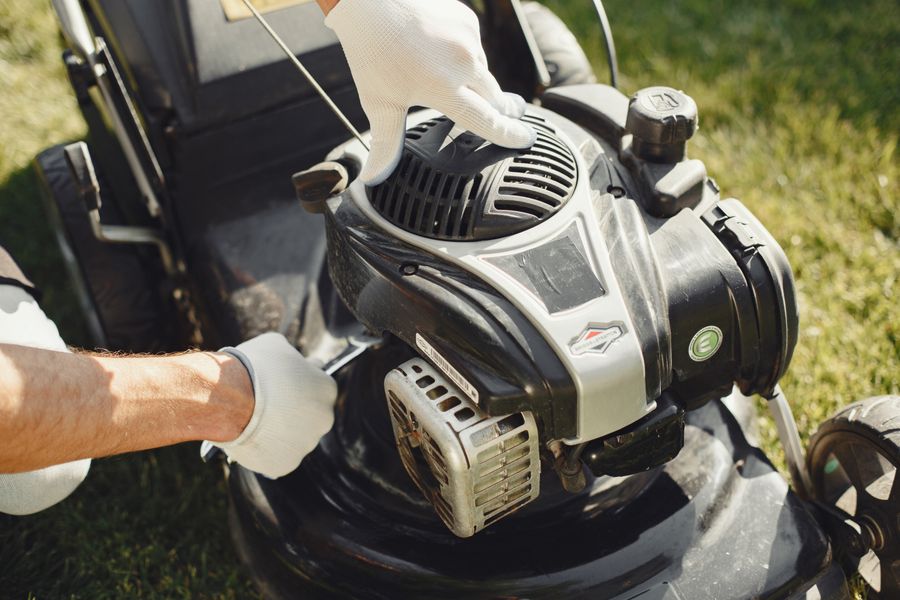
Photo by Gustavo Fring on Pexels
How to tell if it's the carb: Black smoke combined with the smell of raw gasoline, the engine running very rough or surging, and the mower sometimes dying under load are all signs of carburetor flooding.
Quick field fix for a temporary flood: Turn the choke to fully open, set the throttle to full, and crank the engine several times without the air filter installed to help burn off excess fuel. If the mower clears up and runs clean after 2–3 minutes, you're likely okay to finish the cut.
When to stop: If the black smoke doesn't clear after 3–5 minutes of running, or if you can smell raw fuel strongly from the exhaust, stop mowing. A severely flooded carb can hydrolock an engine or wash the oil off cylinder walls — both expensive problems.
Pro Tip: If you're dealing with a carburetor issue, this is a sign that stale fuel is already in your system. After finishing the season, run the mower until it dies from fuel starvation, then drain any remaining fuel from the tank. Log the date in Tondio as your "fuel drain" step in your winterization checklist so you don't skip it.
Can You Safely Finish the Last Few Cuts? Here's How to Decide
Fall mowing has a real deadline. Most cool-season grasses like Kentucky bluegrass, tall fescue, and fine fescue need their final cut between late October and mid-November, when soil temperatures drop below 50°F (10°C). Miss it, and your grass goes into winter too long, which increases the risk of snow mold, matting, and rodent damage.
So yes — the urgency is real. But so is the risk of pushing a sick engine through 2–3 more hours of work.
Use this decision tree:
✅ Safe to Finish the Season (After Quick Fix)
- Black smoke clears up after you replace the air filter
- Black smoke clears up after correcting the choke position
- Black smoke clears within 3–5 minutes of running after a temporary flood situation
- Mower runs smoothly at full throttle with no surging, bogging, or raw fuel smell
- You have 2 cuts or fewer left before storage
🛑 Stop and Repair Before Continuing
- Black smoke continues after replacing the air filter and checking the choke
- Strong raw gasoline smell from the exhaust that doesn't go away
- Engine surges, bogs under load, or dies repeatedly during the cut
- You notice black, sooty buildup around the exhaust port
- The mower runs noticeably hotter than usual (you can feel more heat radiating off the engine)
- You have more than 3 cuts still needed — not worth the compounding risk
The honest truth: If a quick air filter swap clears the smoke and the engine runs smoothly, you're probably fine to finish the season. If the problem is carburetor-related and it's not resolving on its own after a few minutes, you're putting real money at risk by continuing to run it.
Pro Tip: Use Tondio to track your remaining mow count for the season. If you know you have exactly 2 cuts left, that changes your risk calculus versus not knowing where you are in the season. Planning your last cut date around expected soil temperatures takes the guesswork out entirely.
End-of-Season Repair vs. Storage: What to Actually Do
Whether you do a quick fix and finish the season or stop now, you still need to address the root cause before the mower goes into storage for the winter. Here's why: a clogged air filter or stuck carburetor left sitting for 4–5 months gets significantly worse. Varnish hardens. Linkages seize. What's a $10 fix in November becomes a $150 carburetor rebuild in April.
End-of-Season Maintenance Checklist for Black Smoke Issues
- Replace the air filter (foam or paper, depending on your model)
- Inspect and clean the choke plate and linkage; lubricate cable with light machine oil
- Drain fuel completely or add a quality fuel stabilizer (like Sta-Bil) to the tank
- Run the engine for 2–3 minutes after adding stabilizer so it circulates through the carb
- If carb flooding was the issue: clean or rebuild the carburetor, or have a shop do it before spring
- Check spark plug condition — black, sooty plugs confirm a rich running condition and should be replaced
- Change the engine oil before storage, not in spring (old oil contains combustion byproducts that corrode internal components over winter)
- Log all completed maintenance in Tondio with dates so you have a full service record come spring
Common Mistakes to Avoid
Ignoring black smoke and hoping it resolves itself. It won't. The underlying cause — restricted airflow or excess fuel — only gets worse with continued use.
Cleaning a paper air filter instead of replacing it. Tapping it against your hand knocks out some debris but leaves oils and fine particles embedded in the paper fibers. A damaged paper filter is worse than no filter.
Assuming it's a carburetor problem without checking the air filter first. The air filter is a 3-minute check and a $10 fix. Always start there.
Storing the mower with stale fuel in the tank. This is how carburetors get gummed up in the first place. Drain it or stabilize it — no exceptions.
Running the choke closed during normal mowing. Some beginner operators leave the choke partially engaged thinking it helps performance. It does the opposite and is a classic black smoke cause.
The Bottom Line
Black smoke from your lawn mower is telling you one clear thing: your engine is getting too much fuel and not enough air. In fall, the most likely culprit is a clogged air filter that's been collecting debris all season. Check that first — it takes 5 minutes and costs less than $15. If that's your issue, fix it and finish your last cuts.
If the smoke continues after that fix, or if you're smelling raw fuel and the engine is running rough, stop mowing. A carburetor issue that gets ignored through the last few weeks of fall mowing can turn into a full engine repair bill before your first spring cut.
Your lawn needs that final fall mow. Your mower just needs 20 minutes of attention first.
Track your mowing schedule, equipment maintenance, and seasonal reminders all in one place with Tondio — so next fall, you're not troubleshooting on the fly when the clock is ticking.