Why Is My Lawn Mower Smoking White and What to Do Before You Run It Again

By Tondio Team · AI-generated content
White smoke from your mower could be harmless or engine-destroying. Learn the causes, how to diagnose them fast, and whether to keep mowing or stop immediately.
Why Is My Lawn Mower Smoking White and What to Do Before You Run It Again
White smoke coming from your mower is not something you ignore and push through. It's your engine sending up a distress signal — and whether that signal means "relax, this is normal" or "shut me off right now before you destroy me" depends entirely on when it happens and what else you're seeing.
Every spring, thousands of homeowners yank the pull cord on a mower that's been sitting in a cold garage since October, see a puff of white smoke, and either panic unnecessarily or — worse — shrug and keep mowing straight into a $300–$600 repair bill. You don't need to be either of those people.
This guide will walk you through every realistic cause of white smoke, tell you exactly how to diagnose it in your driveway, and give you a clear stop or keep mowing decision for each scenario. No guessing. No textbook jargon. Just what you actually need to know.
White Smoke at First Startup vs. White Smoke Mid-Mow — Why the Timing Changes Everything
Before you diagnose anything, ask yourself one question: When did the smoke appear?
This single piece of information narrows the list of causes dramatically and tells you a lot about the urgency of the problem.
White Smoke on the First Start of the Season
If your mower fires up for the first time in spring and pushes out a thin white or light bluish-white smoke that disappears within 30–60 seconds, you can almost always breathe easy. Here's why:
During storage, small amounts of oil can migrate past the piston rings and settle into the combustion chamber. Condensation also builds up in the exhaust system over winter. When you start the engine cold, that residual oil and moisture burns off fast — producing that brief puff of white or light gray smoke.
As long as the smoke clears completely within about a minute and the mower runs smoothly after that, this is normal. No action required beyond letting it warm up.
What you don't want to see:
- Smoke that persists longer than 60–90 seconds
- Smoke that gets thicker as the engine warms up
- Any smoke accompanied by a burning oil smell that doesn't go away
- Oil residue around the exhaust port or air filter housing
White Smoke Mid-Mow
This is the scenario that demands your full attention. If your mower starts fine, runs for 5–20 minutes, and then begins smoking white — stop the engine immediately.
Mid-mow white smoke is almost never a burn-off situation. It tells you something is actively wrong right now, and continuing to run the engine under load is like driving your car with the oil light on at highway speed. Every extra minute increases the damage.
The three most common causes of mid-mow white smoke are:
- Oil overfill — excess oil being forced into the combustion chamber under running conditions
- Tilting or tipping the mower — temporarily flooding the combustion chamber with oil
- Head gasket failure — the most serious and expensive scenario
We'll cover each one in detail below.
Pro Tip: Start logging your mower's first startup date and any observations — smoke, sounds, smells — each season using Tondio. A 30-second note in the app at spring startup gives you a comparison baseline if something goes wrong mid-season.
How to Check and Fix Oil Overfill (The #1 Cause of White Smoke)
Overfilling the crankcase with oil is by far the most common reason a mower smokes white, and it's almost always self-inflicted during a spring oil change. Most small engine crankcases hold between 0.6 and 0.65 liters (20–22 oz) of oil — which is less than most people expect. It's shockingly easy to pour in too much.
Here's what happens when you overfill: the crankshaft dips into the excess oil and whips it into a foam. That aerated oil gets forced past the piston rings and into the combustion chamber, where it burns. The result is persistent white or blue-white smoke, often accompanied by a distinct oily smell.
How to Check Your Oil Level the Right Way
- Park the mower on a flat, level surface. This is non-negotiable. Even a slight incline gives you a false reading.
- Let the engine cool for at least 5 minutes after running (or check before the first start).
- Remove the dipstick, wipe it completely clean with a rag, reinsert it fully, then pull it out again. Don't screw it in on the second pull — just seat it.
- Read the oil level. It should sit between the MIN and MAX marks, ideally closer to MAX but not above it. On most residential push mowers, the difference between MIN and MAX is only about 4–5 oz (120–150 ml) — a small margin.
If the oil is above the MAX mark, you have your answer. The mower is overfilled, and you need to drain some before running it again.
How to Remove Excess Oil
You have three practical options:
- Turkey baster or oil extractor pump — Insert into the dipstick tube and suck out oil in small increments, checking the level after each pull. This is the cleanest method and costs about $10–$15 at any hardware store.
- Drain plug method — If you're comfortable doing it, drain all the oil from the drain plug on the bottom of the deck and refill with the exact specified amount from your owner's manual.
- Tilt drain — Tilt the mower onto its side (carburetor side up, always — more on this below) and let a small amount drain from the oil fill port. This is the least precise method, but it works in a pinch.
After correcting the oil level, start the mower and let it idle for 2–3 minutes. You may see some residual smoke as the oil already in the combustion chamber burns off. If the smoke clears within 90 seconds and doesn't return, you've solved the problem.
The "I Just Tipped My Mower Over" Scenario
If you tilted your mower to clean the deck or inspect the blade and white smoke appeared on the next start, you likely dumped oil into the combustion chamber. Always tilt a mower with the carburetor and air filter facing up. Tilting it the wrong way — carburetor down — allows oil to flow directly into the air filter and cylinder.
If this happened to you, remove the spark plug and crank the engine a few times to expel any pooled oil before restarting. Dry out or replace the air filter if it's oil-soaked.
Pro Tip: After completing an oil change, log the exact amount used, the oil type, and the date in Tondio. If white smoke shows up two weeks later, you'll know immediately whether overfill is a suspect — instead of trying to remember what you did in the garage on a Saturday morning.
Signs Your White Smoke Is a Head Gasket Failure (And Why You Must Stop Immediately)
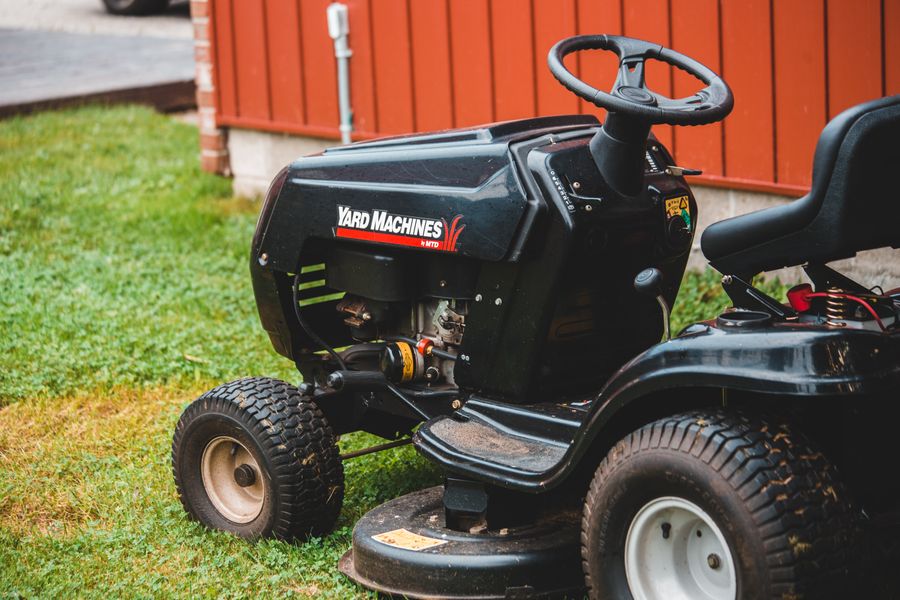
Photo by Erik Mclean on Pexels
If you've confirmed your oil level is correct and the smoke isn't clearing up — especially if you're mid-mow — the conversation gets more serious. A blown head gasket is the white smoke scenario that separates a $20 fix from a potential engine replacement, and the variable that determines which one you're facing is how long you keep running the engine after it starts smoking.
What a Head Gasket Does and Why It Fails
The head gasket seals the combustion chamber between the engine block and the cylinder head. It keeps oil, coolant (on liquid-cooled engines), and combustion gases in their designated lanes. When it fails — due to overheating, age, or a manufacturing defect — oil or combustion gases can leak into places they shouldn't be.
On small air-cooled engines like the ones in most walk-behind mowers, head gasket failure typically allows oil to seep into the combustion chamber, where it burns and produces continuous, persistent white or blue-white smoke. Unlike the burn-off scenario at startup, this smoke doesn't stop. It may actually get worse as the engine reaches full operating temperature (around 300–400°F on a small air-cooled engine).
Warning Signs That Point to the Head Gasket
Look for a combination of these:
- Smoke that doesn't stop — runs continuously at idle and under load
- Oil consumption without visible leaks — you're losing oil but there's no puddle on the ground
- Oil around the exhaust port or muffler — dark, baked-on residue that's new
- Loss of engine power — the mower bogs down under normal cutting load
- Engine overheating — shutting down on its own or running rough after 10–15 minutes
- Milky or foamy oil on the dipstick — this indicates combustion gases are contaminating the oil (more common on liquid-cooled engines, but worth checking)
- A compression drop — if you have an inexpensive compression tester ($20–$30 at any auto parts store), healthy small engines should read between 90–120 PSI. A blown head gasket often shows readings below 60–70 PSI
You don't need all of these signs to be concerned. Persistent white smoke on a mower with correct oil level is enough to warrant stopping the engine and investigating before running it again.
Why Continuing to Run It Is So Costly
Here's the math that makes this decision easy: A head gasket replacement on a typical push mower engine runs $150–$300 in parts and labor if caught early. If you keep running the engine and the gasket failure leads to oil starvation or overheating that scores the cylinder walls or seizes the piston, you're looking at $300–$600+ in engine repair or replacement — or you're simply buying a new mower.
The window between "fixable gasket" and "ruined engine" can be as short as 15–20 minutes of continued operation. That's not a risk worth taking for the sake of finishing one more pass on the lawn.
Pro Tip: If you suspect a head gasket issue, photograph the exhaust port, the dipstick reading, and the oil condition and save them to your equipment record in Tondio. When you bring the mower to a small engine shop, those photos give the mechanic context immediately and can speed up diagnosis.
Other White Smoke Causes Worth Knowing
The big three — burn-off, overfill, and head gasket — cover the majority of white smoke situations. But there are a couple of other causes worth a quick mention so you're not blindsided.
Wrong Oil Type or Old Degraded Oil
Using the wrong viscosity oil (like a high-viscosity 20W-50 when your engine calls for SAE 30 or 10W-30) can cause smoke, especially in cooler spring temperatures. Old, degraded oil from a mower that wasn't stored properly can also burn differently than fresh oil.
The fix: Drain and replace with the manufacturer-specified oil type. Most air-cooled small engines call for SAE 30 in warmer weather (above 40°F) or 10W-30 for variable spring temperatures.
Air Filter Contamination
An air filter that's been soaked with oil (from improper tipping, overfill, or storage) restricts airflow and causes a rich fuel/oil mixture that can produce white or bluish smoke.
The fix: Inspect the air filter. Foam filters can be washed, dried completely, and re-oiled lightly with clean motor oil. Paper filters that are oil-soaked should be replaced — typically a $5–$15 part.
Stop or Keep Mowing? A Quick-Reference Decision Guide
Use this as your field decision tool any time you see white smoke:
| Situation | Smoke Behavior | Action |
|---|---|---|
| First start of spring, mower stored over winter | Clears within 60 seconds | ✅ Keep mowing — normal burn-off |
| First start of spring | Persists beyond 90 seconds | 🛑 Stop — check oil level |
| Just did an oil change | Smoke on startup | 🛑 Stop — check for overfill |
| Tipped mower carburetor-side down | Smoke on next start | 🛑 Stop — clear oil from cylinder |
| Mid-mow, correct oil level | Persistent white smoke | 🛑 Stop immediately — suspect head gasket |
| Mid-mow, oil above MAX on dipstick | White smoke | 🛑 Stop — drain excess oil before restarting |
| Smoke clears, but returns mid-mow | Intermittent smoke | 🛑 Stop — further diagnosis needed |
Your Spring Startup White Smoke Checklist
Before you pull the cord for the first time this season — or before you restart after seeing white smoke — run through this list:
- Confirm mower is on a flat, level surface before checking oil
- Check oil level with a clean dipstick, two-step method
- Verify oil type matches manufacturer spec (check owner's manual or engine tag)
- Inspect air filter — clean or replace if oil-soaked or clogged
- Check for oil residue around the exhaust port or muffler (sign of ongoing issue)
- Note when the smoke appears — startup vs. mid-mow — before diagnosing
- If smoke persists beyond 90 seconds after startup, stop the engine
- If mid-mow smoke appears, stop immediately and don't restart until diagnosed
- Log oil level, oil type, and any observations in Tondio before your first mow of the season
Conclusion
White smoke is your mower talking to you — and now you speak the language. A brief puff at spring startup is almost always harmless. Persistent smoke after 90 seconds, or any smoke that appears mid-mow, is a signal to shut it down and investigate before you turn a manageable problem into an expensive one.
Nine times out of ten, white smoke traces back to an overfilled crankcase. It takes two minutes to check, five minutes to fix, and saves you from a repair bill that costs more than a new mower. The tenth time — when it's a head gasket — the only right answer is to stop running the engine immediately and get it looked at.
Your spring lawn doesn't deserve a broken mower, and your wallet doesn't deserve an avoidable engine rebuild. Take five minutes now, confirm your oil level, and start the season with confidence.
And if you want to stay ahead of these issues before they become problems, use Tondio to set seasonal maintenance reminders, log your equipment records, and track exactly when you last serviced your mower. Catching the pattern early — like noticing you've topped off oil twice in one season — is often the first clue that something bigger is developing.