Summer lawn watering schedule: how deep and how often for your grass type

Photo by Valentin Ivantsov on Pexels
By Tondio Team · AI-generated content
Stop guessing at watering schedules. Learn how soil type, grass species, and humidity determine the perfect depth and frequency for summer irrigation.
Most lawns don't fail in July because of the heat—they fail because they were watered wrong in June.
You've heard "water 1 inch per week" a thousand times. But that generic advice ignores the three factors that actually determine whether your grass survives peak summer: your soil's water-holding capacity, your grass species' root architecture, and your region's evapotranspiration rate. Water too shallow and too often, and you're training roots to stay in the top inch of soil where they'll fry the moment temperatures hit 90°F. Water too deep but too infrequently, and you're stressing the turf between sessions, inviting weeds and disease.
The difference between a lawn that thrives through summer and one that limps into fall comes down to watering to the root zone depth your specific grass type needs, at the frequency your specific soil demands. Here's how to dial it in precisely.
Why Root Depth Determines Everything
Your grass's heat tolerance isn't about the blades—it's about how deep the roots can reach for moisture when surface soil dries out. Shallow roots (top 2-3 inches) mean your lawn is constantly on the edge of drought stress. Deep roots (4-8 inches) access moisture reserves that last days longer between waterings.
Cool-Season Grasses: Deep Roots, Deep Water
Tall fescue, Kentucky bluegrass, and perennial ryegrass need to push roots 6-8 inches deep to survive summer heat. These grasses evolved in cooler climates—their summer survival strategy is going deep for water while the top growth slows down.
- Target root zone depth: 6-8 inches
- Water penetration per session: 4-6 inches minimum
- Why it matters: Once soil temps hit 70°F at the surface, cool-season grass roots stop growing outward and down. Whatever root mass you built by June is what you're working with until September.
Common mistake: Watering cool-season lawns 15 minutes every other day. You're wetting the top 1-2 inches repeatedly, encouraging roots to stay shallow. When July heat arrives, those surface roots bake and you're watering daily just to keep the grass from going dormant.
Warm-Season Grasses: Shallower But Still Deep
Bermudagrass, zoysiagrass, St. Augustine, and centipedegrass thrive in summer but still need 4-6 inch root depth for peak performance. These species are more drought-tolerant by nature, but shallow watering still creates problems.
- Target root zone depth: 4-6 inches
- Water penetration per session: 3-5 inches minimum
- Why it matters: Warm-season grasses grow actively in summer heat, but shallow roots increase fertilizer burn risk and make them vulnerable to grub damage (grubs feed in the top 3 inches).
Pro tip: Bermudagrass can root 6+ feet deep under ideal conditions, but residential lawns typically max out at 6-8 inches. Your goal is keeping that top 6 inches consistently moist but not saturated.
The Soil Factor: Clay vs. Sand vs. Loam
Your soil type determines how long water stays in the root zone and therefore how often you need to water. Ignore this and you're either overwatering (wasting water, promoting disease) or underwatering (stressing grass between sessions).
Clay Soil: Holds Water, Drains Slowly
Clay particles are tiny and pack tightly—water infiltrates slowly (0.1-0.3 inches per hour) but stays available for 4-7 days after a deep watering.
Your watering strategy:
- Water every 5-7 days during early summer, every 4-5 days during peak heat
- Apply 0.75-1.0 inches per session
- Use cycle-and-soak: Water 10-15 minutes, wait 30-60 minutes for infiltration, repeat 2-3 times
- Why: Watering too fast causes runoff before water penetrates to the root zone. Breaking it into cycles lets clay absorb deeply.
The screwdriver test: 12-24 hours after watering, push a long screwdriver (or soil probe) into the lawn. In clay, you should feel consistent resistance until 4-6 inches down, then firmer resistance as you hit drier soil. If it stops easily at 2 inches, you're not watering long enough.
Sandy Soil: Drains Fast, Holds Less
Sand particles are large with big gaps—water infiltrates quickly (0.8-1.2 inches per hour) but drains away in 1-3 days.
Your watering strategy:
- Water every 3-4 days during early summer, every 2-3 days during peak heat
- Apply 0.5-0.75 inches per session
- Water in a single session—no cycle-and-soak needed since infiltration is fast
- Why: Sandy soil can't hold enough water for 5-7 day intervals. More frequent (but still deep) watering keeps the root zone consistently moist.
The screwdriver test: In sand, the screwdriver should slide easily to 4-6 inches within 1-2 hours of watering. If it stops at 3 inches, increase your watering duration by 30-40%. Sandy soils dry from the top down quickly—check again 2 days later to see how far the moisture has drained.
Loam: The Goldilocks Soil
Balanced mix of clay, sand, and silt—water infiltrates at 0.4-0.6 inches per hour and stays available for 3-5 days.
Your watering strategy:
- Water every 4-6 days during early summer, every 3-4 days during peak heat
- Apply 0.75-1.0 inches per session
- Single session or light cycle-and-soak if you have any slope
Pro tip: Most residential lawns aren't pure sand, clay, or loam—they're a mix. Start with the schedule for your dominant soil type, then use Tondio to track watering dates and grass response. If you see wilting before your next scheduled watering, increase frequency. If you see fungal pressure (mushrooms, dollar spot, brown patch), reduce frequency or improve drainage.
The Screwdriver Test: Stop Guessing, Start Measuring
Forget irrigation timers and "inches per week" estimates. The screwdriver test tells you exactly whether water reached your target depth.
How to Perform the Test
-
Choose your tool: A 6-8 inch flat-head screwdriver or a dedicated soil probe. Avoid Phillips-head (doesn't penetrate as cleanly).
-
Wait 12-24 hours after watering: This gives water time to fully infiltrate. Testing immediately after watering only shows surface saturation.
-
Push straight down with steady pressure: The screwdriver should slide through moist soil easily, then meet firm resistance when you hit dry soil.
-
Measure depth: Pull out the screwdriver and note where the soil color changes from dark (moist) to light (dry). That's your water penetration depth.
-
Compare to target:
- Cool-season grass: Need 4-6 inches of moist soil
- Warm-season grass: Need 3-5 inches of moist soil
- Adjust your watering duration if you're consistently short or over your target
What Different Depths Tell You
- Moist to 2 inches only: You're watering too briefly or runoff is preventing penetration. Increase duration by 50% or implement cycle-and-soak.
- Moist to 4-6 inches: Perfect for most grasses. Maintain this schedule.
- Moist to 8+ inches: You're overwatering or have drainage issues. Reduce duration and check for compaction or poor grading.
Track it in Tondio: Log your screwdriver test results alongside watering events. After 3-4 tests, you'll know exactly how long to water to hit your depth target, and you can set up automated reminders for the right frequency.
Early Summer vs. Peak Summer: Adjusting for Heat and Humidity
Your watering needs change as the season progresses because evapotranspiration (ET) rates increase with temperature and decrease with humidity.
Early Summer (May-June): Establishing the Pattern
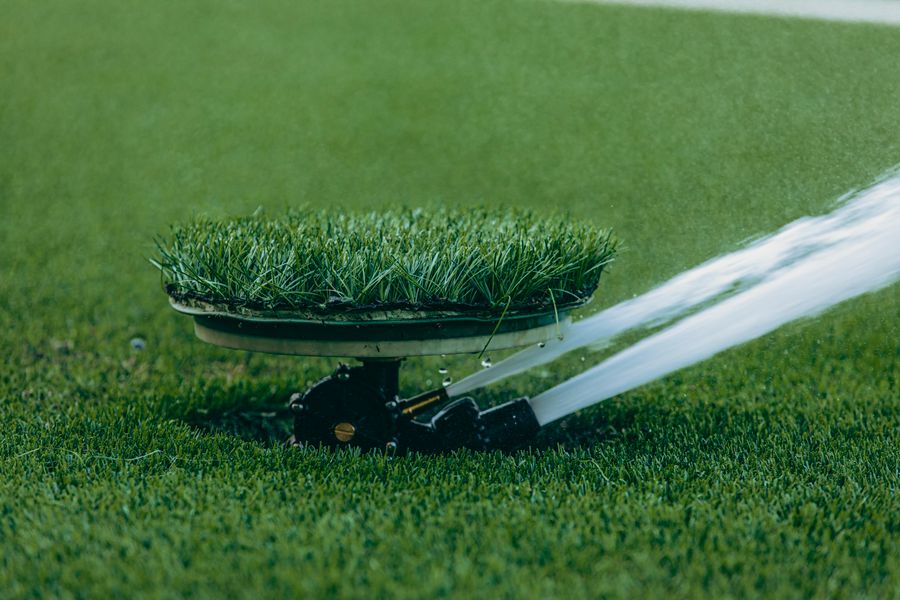
Photo by Chris wade NTEZICIMPA on Pexels
- Temperatures: 75-85°F daytime highs
- Grass behavior: Active growth, building root mass
- Evapotranspiration: Moderate (0.15-0.25 inches/day)
Your watering approach:
- Start with base frequency for your soil type (every 4-7 days depending on soil)
- Water early morning (4-8 AM) to minimize evaporation and allow leaf blades to dry before evening (reduces fungal risk)
- Apply full depth target (3-6 inches depending on grass type)
Why start deep now: You're training roots to grow down while soil temperatures are still favorable for root growth. Every inch deeper your roots go in May-June adds 2-3 days of drought buffer in July-August.
Use Tondio to document growth patterns and watering dates. Take photos from the same spot weekly—you'll see whether your turf is thriving (dark green, dense) or stressed (lighter color, slower growth).
Peak Summer (July-August): Managing Heat Stress
- Temperatures: 85-95°F+ daytime highs
- Grass behavior: Slowed growth (cool-season) or peak growth (warm-season)
- Evapotranspiration: High (0.25-0.40 inches/day)
Your watering approach:
- Increase frequency by 1-2 days (so every 5-7 days becomes every 4-5 days)
- Maintain same depth target—roots need deep water even more now
- Consider light syringing (5-minute watering mid-day) if temps exceed 95°F and grass shows heat wilt (footprints stay visible, blades don't spring back)
Why adjust now: ET rates can nearly double from June to August. The root zone dries faster even though you're applying the same depth. You'll notice this when grass shows wilt symptoms a day earlier than your schedule.
Regional humidity factors:
- High humidity regions (Southeast, Gulf Coast): Lower ET rates mean you can stretch intervals longer—grass in 90°F with 70% humidity needs less frequent watering than grass in 90°F with 30% humidity
- Low humidity regions (Southwest, Plains): Higher ET rates mean shorter intervals—your sandy soil might need watering every 2 days when temps hit 95°F+
Common mistake: Reducing watering depth when increasing frequency. You end up watering every 3 days but only penetrating 2 inches—exactly the opposite of what peak summer demands. Always maintain root zone depth even when increasing frequency.
Your Summer Watering Action Plan
Here's how to dial in your exact schedule:
Week 1: Baseline Testing
- Perform the screwdriver test in 3-5 spots across your lawn
- Identify your average soil type (clay, sand, or loam)
- Measure current root depth by pulling a small plug (use a soil probe or trowel)
- Set up your lawn in Tondio and log your current watering schedule
Week 2-3: Calibration
- Water according to your soil type's recommended schedule
- Perform screwdriver test 12-24 hours after each watering
- Adjust watering duration until you consistently hit 4-6 inches (cool-season) or 3-5 inches (warm-season)
- Log each watering event and test result in Tondio
Week 4+: Fine-Tuning and Maintenance
- Watch for early wilt signals: footprinting, blue-gray color, leaf blades folding
- If wilt appears before your next scheduled watering, increase frequency by 1 day
- If you see fungal activity (mushrooms, disease spots), decrease frequency by 1 day or improve air circulation
- Perform screwdriver test weekly for first month, then bi-weekly once dialed in
- Use Tondio's photo documentation to track turf density and color—deep, infrequent watering produces visibly thicker turf
Monthly Review
- Compare current month's temperature/humidity to last month
- Adjust frequency if temps increased 5-10°F sustained
- Check ET rates for your region (local ag extension or weather stations publish this)
- Review your Tondio logs to see patterns—which watering intervals produced best growth? Any correlation with disease pressure?
Pro tip: If you manage multiple properties or lawn sections with different grass types, Tondio's multi-location tracking lets you maintain separate schedules and notes for each area. No more mental math trying to remember which section got watered when.
Common Questions and Troubleshooting
Q: My grass shows wilt 2 days after watering—am I not watering deep enough?
Not necessarily. Perform the screwdriver test. If water reached 4-6 inches but grass wilts in 2 days, you likely have:
- Compacted soil preventing roots from accessing deep moisture
- Thatch layer (>0.5 inches) blocking water penetration
- Shallow root system from previous shallow watering—give it 4-6 weeks of deep watering to develop deeper roots
Q: Can I water in the evening instead of morning?
You can, but evening watering increases disease pressure by 200-300% because grass blades stay wet for 12+ hours (ideal for fungal spores). If morning watering is impossible, late afternoon (4-6 PM) is better than late evening.
Q: Should I adjust for rainfall?
Yes. Measure rainfall with a rain gauge (or check local weather data). If you get 0.75+ inches of rain, skip your next watering and push the schedule back by your normal interval. Light rain (<0.5 inches) often doesn't penetrate deep enough to count as a full watering.
Q: My sprinkler system has fixed zones with different run times—how do I ensure even depth?
Place catch cans (tuna cans work great) in multiple spots in each zone. Run your system for your normal cycle. Measure water depth in each can. Adjust zone run times so each zone delivers the same total depth. This also reveals low-pressure areas or broken sprinkler heads.
The Long Game: Building Drought-Resistant Turf
Here's what most homeowners miss: your summer watering strategy isn't just about keeping grass alive this year—it's about building a root system that gets stronger every season.
Grass that's deep-watered infrequently develops:
- 30-50% deeper roots than shallow-watered grass
- Better nutrient uptake (nitrogen and phosphorus concentrate 4-8 inches down in many soils)
- Higher stress tolerance—handles heat, traffic, and drought better
- Lower water requirements long-term as roots access deeper moisture reserves
Grass that's shallow-watered frequently becomes:
- Dependent on constant irrigation—misses one watering and shows stress
- More susceptible to disease (wet surface, dense thatch)
- Weaker during heat waves—no moisture reserves to tap
- Higher maintenance costs—more water, more fertilizer (roots can't access nutrients deeper down), more disease treatment
Track this long-term trend in Tondio—compare photos and notes from this July to next July. Lawns managed with deep, infrequent watering become visibly more resilient season over season.
Get the Depth Right, Everything Else Gets Easier
Summer lawn care isn't complicated—but it is specific. Your exact watering schedule depends on three variables: grass type, soil type, and weather conditions. Generic advice fails because it ignores at least two of those.
Start with the screwdriver test this week. Find out whether your current watering is actually reaching the root zone or just wetting the surface. Adjust your duration until you consistently hit 4-6 inches deep, then dial in your frequency based on how fast your soil dries out.
Your grass will tell you if you're getting it right: deeper green color, thicker density, fewer wilt symptoms between waterings, and better heat tolerance when July peaks.
Ready to stop guessing and start tracking? Set up your lawn in Tondio today and log your first screwdriver test. You'll know exactly what works for your specific lawn—and you'll have the data to replicate it next summer.